Men's Work Boots
Men’s work boots in this section all come from AdTec and include loggers, lacers, packers, Wellingtons, work westerns, hikers and farm and ranch boots. Many have steel or composite toes, and several are waterproof. Heights run from 6 to 12 inches, in sizes 7.5 to 13, with wide fits on many styles.
Showing all 6 results
-

Men’s 10″ Fireman Logger by AdTec
$178.00 Select options This product has multiple variants. The options may be chosen on the product page Compare -
Men’s 6″ Steel Toe Hiker by AdTec
Price range: $108.00 through $110.00 Select options This product has multiple variants. The options may be chosen on the product page Compare -
Men’s 6″ Steel Toe Waterproof Work Boot by AdTec
$139.00 Select options This product has multiple variants. The options may be chosen on the product page Compare -
Men’s 6″ Steel Toe Work Boot by AdTec
Price range: $76.99 through $109.00 Select options This product has multiple variants. The options may be chosen on the product page Compare -
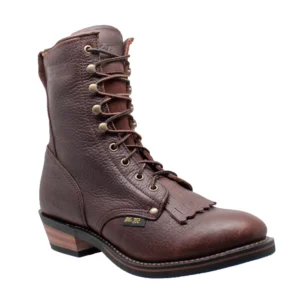
Men’s 9″ Packer by AdTec
Price range: $149.00 through $151.00 Select options This product has multiple variants. The options may be chosen on the product page Compare -
Men’s Steel Toe Work Boot by AdTec
Price range: $118.00 through $125.99 Select options This product has multiple variants. The options may be chosen on the product page Compare



Men's Work Boots Buying Guide
Work boots were made for building sites, farms and forests, but they have long been part of the gear scene too. A heavy lace-up boot with a thick sole says something about the wearer, and it pairs naturally with denim, leather, a harness and a jock. Whether you need boots for a real job, for long hours on your feet, or for the look at a bar night, the same basics apply. This guide explains the main styles, toe and sole options, how to fit a heavy boot, and how to keep it in working order.
Styles you will see
- Lace-up work boots at six or eight inches tall are the everyday standard, giving ankle support without much weight.
- Logger boots are taller, often nine or ten inches, with a raised heel and aggressive tread made for uneven ground. Their height and heft make them a favourite in leather and gear circles.
- Wellington and pull-on boots have no laces and a taller shaft. Ranch and western work styles fall into this group.
- Hiker-style work boots are lighter and more flexible, for people who walk a lot during the day.
- Packer boots lace up the front with a taller shaft and a lower heel than a logger.
Toe protection
Plain toes are lightest and most flexible. Steel toes give strong protection from falling objects and compression, but add weight and conduct cold. Composite toes are lighter and usually pass metal detectors without trouble, which helps if you go through security often. If you need a safety-rated boot for your job, check the listing for the exact standard it meets rather than assuming every protective toe is rated.
Soles, waterproofing and comfort
Deep lugs grip mud and gravel; flatter soles are better on concrete and inside. Look for oil- and slip-resistant soles if you work on smooth floors. A waterproof boot uses a membrane or sealed construction to keep water out; boots that are only water resistant will shed light rain but not standing puddles. Cushioned insoles and a supportive shank matter if you will be standing for a full shift.
Fitting a heavy boot
Wear the thick socks you will actually use and try boots on late in the day. Lace them fully to the top before judging the fit. Your heel should stay mostly in place as you walk, and there should be a thumb's width of space beyond your longest toe, particularly with a protective toe cap, which will not stretch. Wide fittings are worth seeking out if you have broad feet, as a narrow boot never fully gives. Sizes run large in some ranges, so compare the brand's chart.
Height and weight
Taller boots give more ankle support and keep debris out, but each extra inch of leather adds weight you carry all day. If you will walk long distances, a six-inch boot is easier on the legs. For standing work, outdoor jobs or a bold look, a nine-inch or taller boot is worth the extra heft.
Breaking in
Heavy leather takes time to soften. Wear new boots for short periods at first, flex them by hand, and keep laces snug but not cutting off circulation at the instep. A leather conditioner applied early helps the creases form smoothly.
Care
Knock off mud and clean boots after hard use, as dirt draws moisture out of leather. Let them dry slowly at room temperature, never next to a fire or heater. Condition or oil the leather regularly, paying attention to the seams. Replace worn laces and check the sole for separation. A good cobbler can often resole a well-made work boot, giving it a second life.
Wearing work boots as gear
Loggers and tall lace-ups look strongest with straight or rolled jeans, a tank or bare chest under a harness, and a cap. Polish them for a sharp finish, or leave them scuffed for a rough, working look. Some men enjoy boot worship and cleaning as part of a scene, so keep a cloth and leather balm in your kit bag.
Completing the outfit
Browse Harnesses for chest and body harnesses that suit a work boot look, and Jock Straps for the classic underwear that completes a gear outfit.