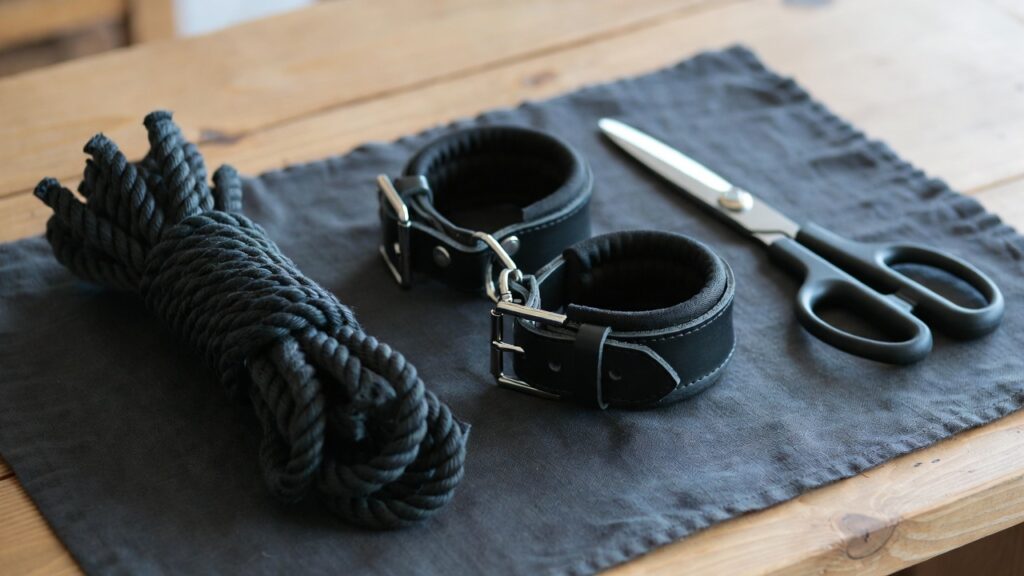
Bondage is about trust: one person gives up the freedom to move, and the other takes responsibility for keeping them safe. Bondage safety comes down to three things: agreeing on what will happen, knowing how restraints can hurt, and being able to undo everything fast. This guide covers the basics for beginners using cuffs, tape and rope.
Bondage safety starts with consent
The National Coalition for Sexual Freedom describes consent as an informed, voluntary agreement made in advance. It covers the activities you agreed on, not anything else, and either person can withdraw it at any time during the scene. Both people need to be clearheaded, not impaired by alcohol, drugs or medication (source below).
Before you start, talk through what you want to try, what is off limits, how long it will last, and any health issues: joint or back problems, poor circulation, breathing trouble, or a tendency to panic when held still.
Agree on a safeword and a safe signal
Pick a safeword that would never come up by accident, such as “red” to stop and “yellow” to slow down. If the bound person will be gagged or unable to speak, agree on a signal instead, such as dropping a set of keys or squeezing a hand three times. When the safeword or signal comes, stop at once and check in.
7 rules for bondage safety
- Never leave a bound person alone, not even for a minute.
- Keep a way out within reach. Blunt-tipped safety shears cut rope and tape in seconds. With locking restraints and handcuffs, keep the keys where you can see them.
- Nothing goes around the neck.
- Leave room to breathe and bleed. You should be able to slide a finger or two under any cuff or wrap. Check hands and feet often: cold, pale or blue skin, tingling or numbness means loosen it now.
- Protect the nerves. In a 2023 medical study of rope bondage injuries, 13 of 16 injuries were to the radial nerve, which runs close to the surface in the middle of the upper arm. The signs were a hand that would not lift at the wrist and numbness on the back of the hand; recovery took from minutes to five months. Keep tight wraps off the upper arm, and untie at once if the bound person reports numbness, tingling or weakness.
- Start short. Begin with a few minutes and change positions often. Arms held overhead tire quickly.
- Stay sober, both of you.
Restraints for beginners
Padded wrist and ankle cuffs are the easiest way to start, because they spread pressure over a wide band and come off quickly. Bondage tape sticks only to itself, not to skin or hair. Spreader bars hold limbs apart without tight wraps, and bondage kits put several pieces together. Add a blindfold only once you both know how the restraints feel.
Choosing bondage rope
For bondage safety, rope takes more practice than cuffs, because every wrap has to be placed and checked. Softer, smoother rope is kinder to skin for a first try, and rope sold for bondage is made to be handled against the body. Bondage rope often comes in lengths from about 16 to 98 feet; shorter pieces are easier to manage while you learn. Browse our bondage rope and shibari rope, and follow the maker’s care instructions for washing.
Leave suspension for later
Lifting a person off the ground with rope is a skill for experienced riggers. In the study above, the injuries came right after full suspension. Learn it in person from an experienced teacher; our kink aware resources list community groups that run classes.
Bondage safety after the scene
Untie slowly and support the limbs as they come free. Check the skin and how the bound person feels, then give them time: water, a blanket and a talk about what worked and what did not. If numbness or weakness lasts after the scene, see a doctor promptly. Good bondage safety is a habit: talk first, check often, and keep the shears close.
Sources
National Coalition for Sexual Freedom, Consent Statement Summary.
Khodulev V. and others, Acute Radial Compressive Neuropathy: The Most Common Injury Induced by Japanese Rope Bondage, Cureus, May 2023.